

Introduction
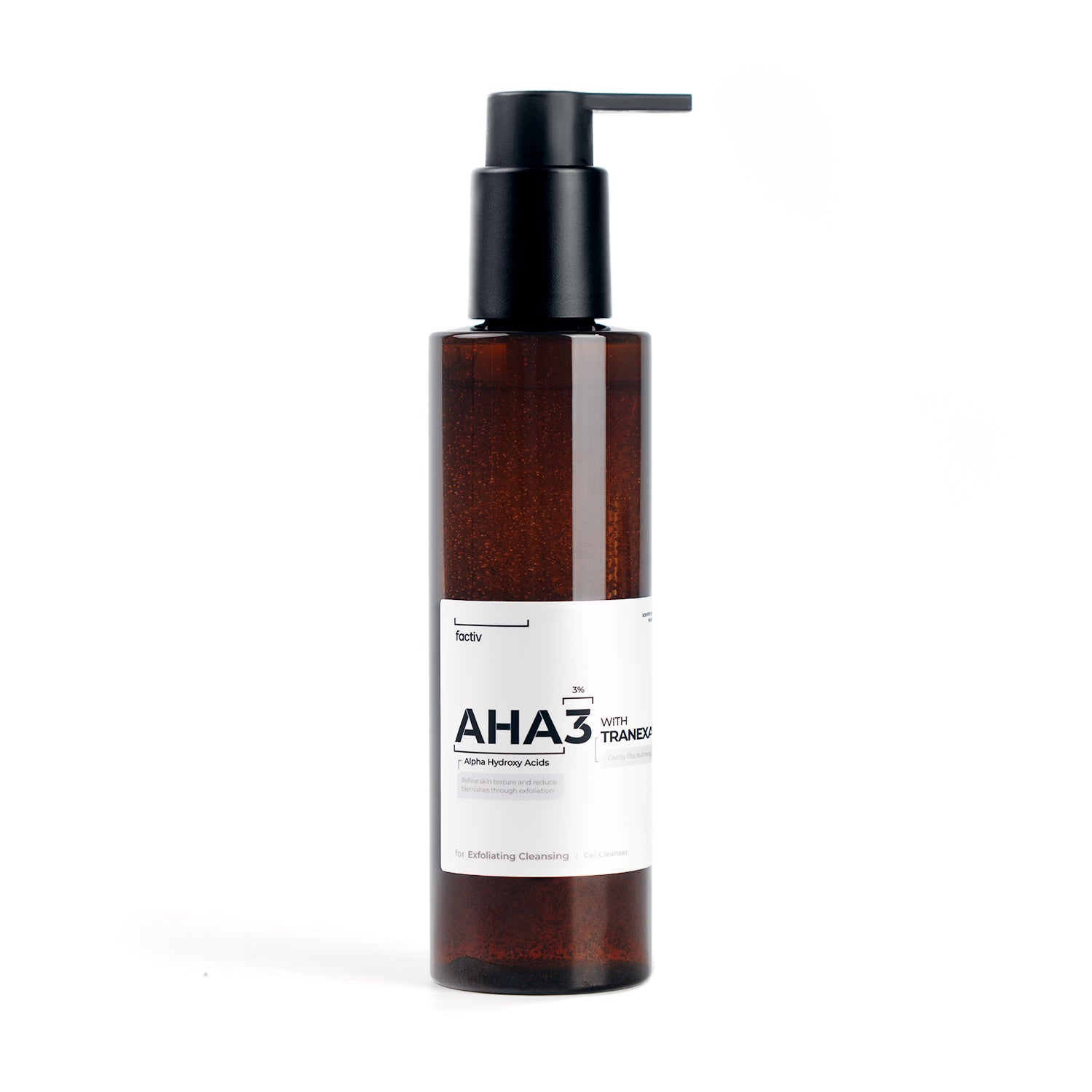
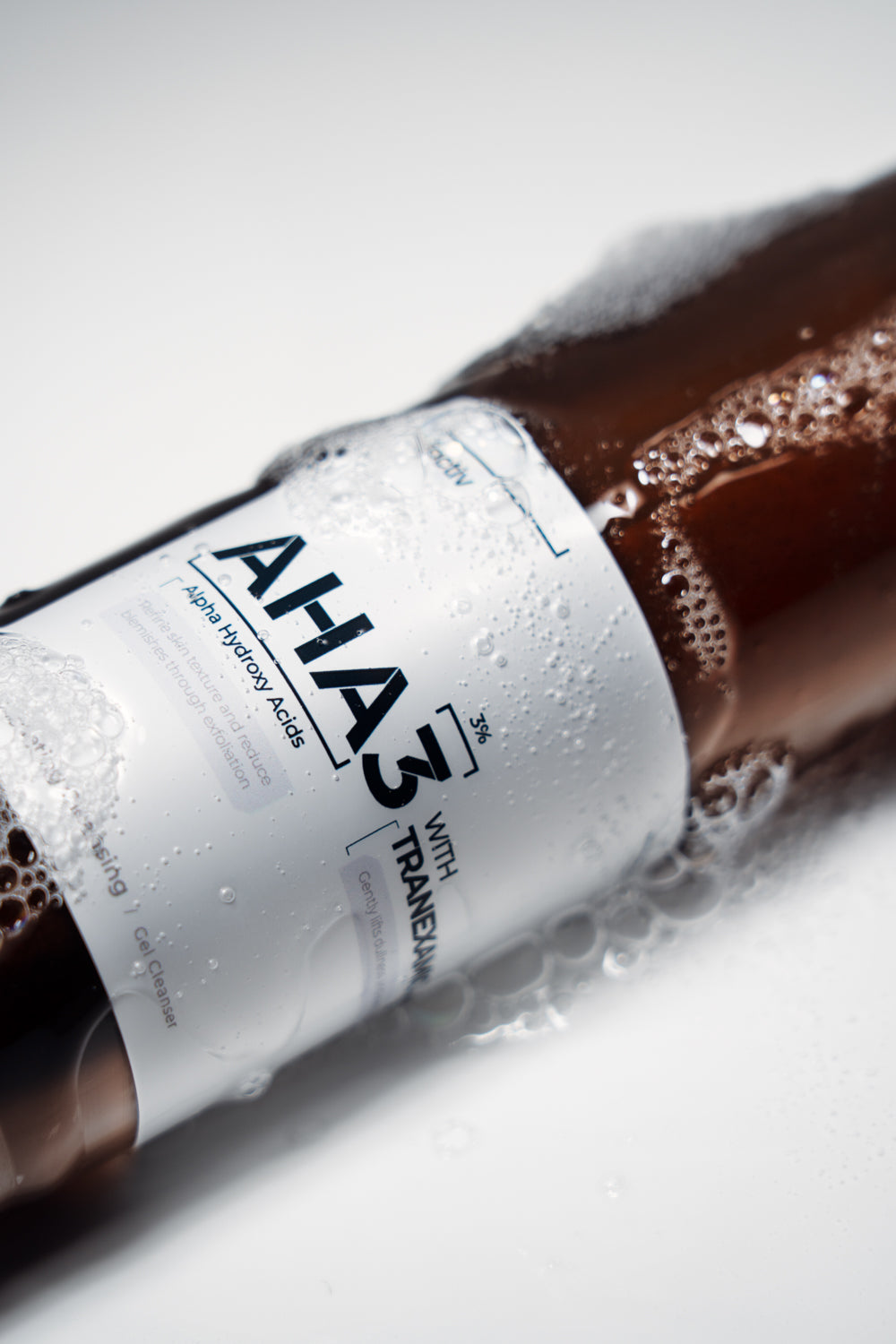
AHA3 with Tranexamic Acid combines natural alpha-hydroxy acids (AHAs) with tranexamic acid, creating a dual-action cleanser that exfoliates, smooths, and brightens the skin. The cleanser includes a 3% concentration of natural AHAs derived from Lactic Acid (bilberry), Glycolic Acid (sugar cane), Citric Acid (orange and lemon), and Malic and Tartaric Acids (sugar maple). AHA is a chemical exfoliant that modulates skin keratinization to even out the skin texture and leave skin with a smooth and radiant appearance, while tranexamic acid is incorporated for its ability to inhibit melanogenesis and reduce pigmentation, contributing to an even, luminous complexion.
Mechanism
AHAs are small water-soluble molecules derived from natural ingredients. Without the need for harsh physical scrubs, AHAs—particularly formulations with enhanced levels of glycolic acid - work chemically on the superficial layers of the epidermis by increasing the skin’s shedding process (Desquamation).
Desquamation is a self-renewal process that allows epidermal cells in the inner epidermis layer to travel upwards, until they reach the outermost stratum corneum. Dead skin cells are then naturally shed and replaced. Normal desquamation is barely noticeable which helps maintain a healthy skin barrier silently. As we age, desquamation takes longer as the stratum corneum regenerates slower, and the glue-like corneodesmosome between cells becomes denser, making cells more difficult to detach 1-3. This causes increased or uneven skin thickness, roughness and dryness.
When applied to the skin, AHAs enhance desquamation by interfering with the ionic bonding between corneocytes, thus promoting epidermal proliferation and allowing dead skin cells to slough off 4-5. Studies have shown that even low levels of AHAs in wash-off products significantly increase skin cell turnover rates, and higher concentrations of glycolic acid further potentiate this effect, underscoring the ingredient’s efficacy in rapid superficial exfoliation and penetration through the skin for its small molecular size 6. Excess oil secretion often leads to pore blockage and contributes to breakouts, especially for those with oily and acne-prone skin. Exfoliation with AHAs helps to unblock the pores by removing dead skin cells from clogging hair follicles 7. It is also suggested in various studies that AHAs are used to reduce comedones, papules and pustules, and to improve follicular pores and skin texture 4,8-9.
Tranexamic acid (TXA) stands out from traditional brighteners by blocking the plasminogen/plasmin pathway. This reduces inflammatory signals that drive pigment production and transfer, helping to fade dark spots and even out skin tone. It works by binding to lysine sites on plasminogen, preventing its conversion to plasmin—a key player in UV-induced release of pro-melanogenic factors like arachidonic acid and prostaglandins. By limiting these signals, TXA curbs melanocyte activity and lowers melanin synthesis, reducing visible hyperpigmentation 10-11. TXA also reduces skin inflammation by blocking plasmin, which normally triggers enzymes and inflammatory signals that cause redness and irritation. This lowers levels of pro-inflammatory cytokines, aiding conditions like hyperpigmentation with inflammation and supporting overall skin barrier health against environmental stressors 11-12.
To effectively remove sebum and dirt from the face, two mild surfactants are incorporated into the gel cleanser. Sodium Lauroyl Sarcosinate (SLS) is a mild, anionic surfactant derived from fatty acids and the amino acid sarcosine. The transmission index (which measures the extent of surfactant effects on the skin barrier function) of sarcosinate surfactants is lower than that of harsh sulfate-containing surfactants13. This indicates that sarcosinate surfactants barely adsorb onto the skin and thus less irritating to the skin. Adding Decyl Glucoside (DG) as a co-surfactant further enhances the mildness of the surfactant system. As a non-ionic surfactant, DG also helps to stabilize anionic amino acid surfactants (i.e. sarcosine in SLS) at low pH environments and to improve their lather properties14.
Formulator’s Note
This product is free of sulfate surfactants such as SLS (Sodium Lauryl Sulfate) and SLES (Sodium Laureth Sulfate). Sodium Lauroyl Sarcosinate, used in this product, is often confused with Sodium Lauryl Sulfate because they share the same initials (SLS). However, it's crucial to note that these two surfactants have remarkably different properties. Sodium Lauroyl Sarcosinate is a mild amino surfactant that effectively and gently removes excess oil and dirt from the face while maintaining the delicate oil-water balance of the skin. In contrast, Sodium Lauryl Sulfate is a harsh sulfate-containing surfactant, potentially leading to dryness, cracking, and dermatitis 15.
As we age, our skin naturally thickens, hindering the absorption of skincare products. To address this, you can adapt the usage of acids according to your specific skin conditions. This promotes exfoliation for improving product absorption and ultimately enhancing their effectiveness. However, it's important to note that excessive exfoliation or high concentrations of acids can harm the skin's native acid mantle and disrupt its inherent microbiome balance, which may weaken the skin's natural defenses. Therefore, gentle exfoliation in daily skincare routine will be crucial in maintaining healthy skin status.
Reference
-
Milstone, L.M., 2004. Epidermal desquamation. Journal of dermatological science, 36(3), pp.131-140.
-
Egelrud, T., 2000. Desquamation in the stratum corneum. Acta Dermato-Venereologica, 80, pp.44-45.
-
DeHaven, C., 2015. Mechanisms of exfoliation. Science of Skincare.
-
Babilas, P., Knie, U. and Abels, C., 2012. Cosmetic and dermatologic use of alpha hydroxy acids. JDDG: Journal der Deutschen Dermatologischen Gesellschaft, 10(7), pp.488-491.
-
Ramos-e-Silva, M., Hexsel, D.M., Rutowitsch, M.S. and Zechmeister, M., 2001. Hydroxy acids and retinoids in cosmetics. Clinics in dermatology, 19(4), pp.460-466.
-
Edison, B.L., Smith, H.A., Green, B.A. and Tierney, N.K., 2021. 27887 Skin exfoliation with low concentrations of alpha hydroxy acids and poly hydroxy acids when incorporated into wash-off or leave-on products using a novel abbreviated model to measure cell turnover rate. Journal of the American Academy of Dermatology, 85(3), p.AB165.
-
Behalpade, S., Gajbhiye, S. and Hills, S., 2022. Review Article: Skin Care With Exfoliation Process. Int. J. Corrent Sci, 12, pp.372-379.
-
WANG, C.M., HUANG, C.L., SINDY HU, C.T. and CHAN, H.L., 1997. The effect of glycolic acid on the treatment of acne in Asian skin. Dermatologic surgery, 23(1), pp.23-29.
-
Sharad, J., 2013. Glycolic acid peel therapy–a current review. Clinical, cosmetic and investigational dermatology, pp.281-288.
-
Cho, Y.H., Park, J.E. and Lee, J.S., 2017. Tranexamic acid inhibits melanogenesis by activating the autophagy system in cultured melanoma cells. Journal of dermatological science, 88(1), pp.96-102.
-
Gaćina, K. and Ćosić, A.K., 2023. The use of tranexamic acid in dermatology. Acta Clinica Croatica, 62(2), p.368.
-
Chen, T., Xue, J. and Wang, Q., 2024. Tranexamic acid for the treatment of hyperpigmentation and telangiectatic disorders other than melasma: An update. Clinical, Cosmetic and Investigational Dermatology, pp.2151-2163.
-
Okasaka, M., Kubota, K., Yamasaki, E., Yang, J. and Takata, S., 2019. Evaluation of anionic surfactants effects on the skin barrier function based on skin permeability. Pharmaceutical Development and Technology, 24(1), pp.99-104.
-
Ananthapadmanabhan, K.P., 2019. Amino-acid surfactants in personal cleansing. Tenside Surfactants Detergents, 56(5), pp.378-386.
-
Löffler, H. and Happle, R., 2003. Profile of irritant patch testing with detergents: sodium lauryl sulfate, sodium laureth sulfate and alkyl polyglucoside. Contact Dermatitis, 48(1), pp.26-32.
GAR1 淨肌去瑕乳液