

Introduction
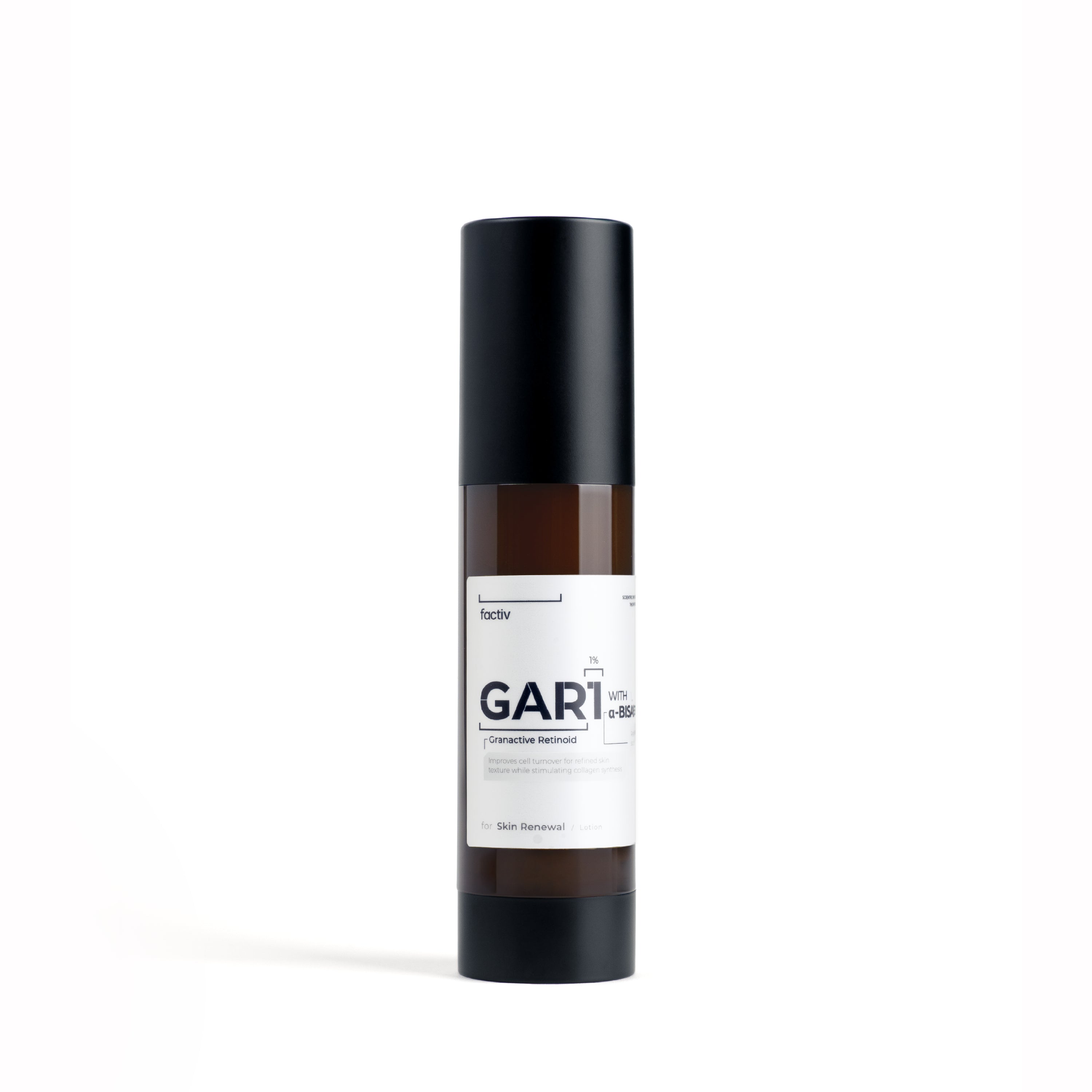
GAR1 with Bisabolol is formulated with 1% concentration of Granactive Retinoid (Hydroxypinacolone retinoate), a newer form of retinoid that offers anti-aging benefits by promoting cellular turnover. Unlike traditional retinoids, it provides these benefits with minimal irritation.
Mechanism
Skin aging results from intrinsic and extrinsic factors such as UV exposure, causing wrinkles, loss of elasticity, pigmentation, and weakened skin barrier. At the cellular level, aging skin features reduced collagen production, increased collagen degradation, and slower cell turnover. Retinoids, vitamin A derivatives, counteract these effects by stimulating keratinocyte proliferation and skin renewal, leading to smoother, firmer skin and reduced wrinkles1. Despite their proven efficacy, traditional retinoids (such as retinol and retinaldehyde) often cause irritation such as redness, peeling, and dryness, which limits their tolerability and consistent use1.
Hydroxypinacolone retinoate (HPR) is a next-generation retinoid, where its molecular structure is a stable, lipophilic ester of retinoic acid that mimics the active form of vitamin A yet resists metabolic conversion. Unlike traditional retinoids that require enzymatic conversion in the skin to the active all-trans retinoic acid that binds retinoic acid receptors (RARs), HPR binds directly and immediately to RARs without metabolic transformation2. This direct binding activates retinoid-responsive genes responsible for skin renewal and collagen synthesis, delivering the biological effects of retinoic acid with enhanced stability and reduced irritation, making HPR suitable even for sensitive skin types3.
The key benefits of HPR arise from its direct activation of retinoid pathways, leading to accelerated collagen synthesis and dermal remodeling that improve skin elasticity and reduce fine lines and wrinkles. HPR also enhances epidermal cell turnover, promoting smoother skin texture and reducing hyperpigmentation2,4. Clinical studies show that HPR delivers comparable anti-aging effects to retinol and tretinoin but with significantly less irritation. Additionally, its anti-inflammatory properties help reduce acne-related inflammation without disrupting the skin barrier, making HPR an effective and well-tolerated retinoid for various skin conditions5-6.
Bisabolol, a natural compound from chamomile, complements HPR by providing strong anti-inflammatory and soothing effects. It reduces pro-inflammatory cytokines like TNF-α and IL-6, inhibiting key pathways involved in skin inflammation. These actions help decrease redness and irritation commonly caused by retinoids, making bisabolol valuable in calming sensitive skin and improving treatment comfort7-9.
Similarly, niacinamide, a form of vitamin B3, synergizes effectively with HPR by enhancing the skin’s barrier function. Through the upregulation of ceramide biosynthesis and other epidermal lipids, niacinamide enhances the integrity of the stratum corneum, reducing transepidermal water loss and thereby preventing dehydration often induced by retinoids. Moreover, niacinamide mitigates inflammation by downregulating pro-inflammatory cytokines such as IL-1β and TNF-α. This anti-inflammatory effect helps alleviate retinoid-associated irritation and supports skin homeostasis9-11.
Reference
-
Mukherjee, S., Date, A., Patravale, V., Korting, H.C., Roeder, A. and Weindl, G., 2006. Retinoids in the treatment of skin aging: an overview of clinical efficacy and safety. Clinical interventions in aging, 1(4), pp.327-348.
-
Wang, Q., Hu, F., Hu, X., Xie, Y., Du, L. and Ye, R., 2023. The synergistic effect of retinyl propionate and hydroxypinacolone retinoate on skin aging. Journal of cosmetic dermatology, 22(7), pp.2040-2049.
-
Temova Rakuša, Ž., Škufca, P., Kristl, A. and Roškar, R., 2021. Retinoid stability and degradation kinetics in commercial cosmetic products. Journal of cosmetic dermatology, 20(7), pp.2350-2358.
-
Bai, D., Hu, F., Xu, H., Huang, J., Wu, C., Zhang, J. and Ye, R., 2023. High stability and low irritation of retinol propionate and hydroxypinacolone retinoate supramolecular nanoparticles with effective anti-wrinkle efficacy. Pharmaceutics, 15(3), p.731.
-
Ruth, N. and Mammone, T. 2018. Antiaging effects of retinoid hydroxypinacolone retinoate on skin models. Journal of the American Academy of Dermatology, 79(3), p.AB44.
-
Kruger, L., Bambino, K., Schmalenberg, K., Santhanam, U., Orentreich, D., Orentreich, C., Logerfo, J. and Saliou, C., 2025. Efficacy of Topical Hydroxypinacolone Retinoate‐Peptide Product Versus Fractional CO2 Laser in Facial Aging. Journal of Cosmetic Dermatology, 24(1), p.e16621.
-
Eddin, L.B., Jha, N.K., Goyal, S.N., Agrawal, Y.O., Subramanya, S.B., Bastaki, S.M. and Ojha, S., 2022. Health benefits, pharmacological effects, molecular mechanisms, and therapeutic potential of α-bisabolol. Nutrients, 14(7), p.1370.
-
Ramazani, E., Akaberi, M., Emami, S.A. and Tayarani-Najaran, Z., 2022. Pharmacological and biological effects of alpha-bisabolol: An updated review of the molecular mechanisms. Life sciences, 304, p.120728.
-
Guerrero, R., Dufort, M., Edison, B., Parsa, R. and Costantino, P., 2023. 44446 The clinical benefits of a 0.3% retinol complex in improvement of pigmentation and anti-aging benefits. Journal of the American Academy of Dermatology, 89(3), p.AB94.
-
Farris, P., Zeichner, J. and Berson, D., 2016. Efficacy and Tolerability of a Skin Brightening/Anti-Aging Cosmeceutical Containing Retinol 0.5%, Niacinamide, Hexylresorcinol, and Resveratrol. Journal of drugs in dermatology: JDD, 15(7), pp.863-868.
-
Marques, C., Hadjab, F., Porcello, A., Lourenço, K., Scaletta, C., Abdel-Sayed, P., Hirt-Burri, N., Applegate, L.A. and Laurent, A., 2024. Mechanistic insights into the multiple functions of niacinamide: Therapeutic implications and cosmeceutical applications in functional skincare products. Antioxidants, 13(4), p.425.
CAT1 離子保濕潔膚乳
AHA3 淨肌亮白潔膚啫喱